
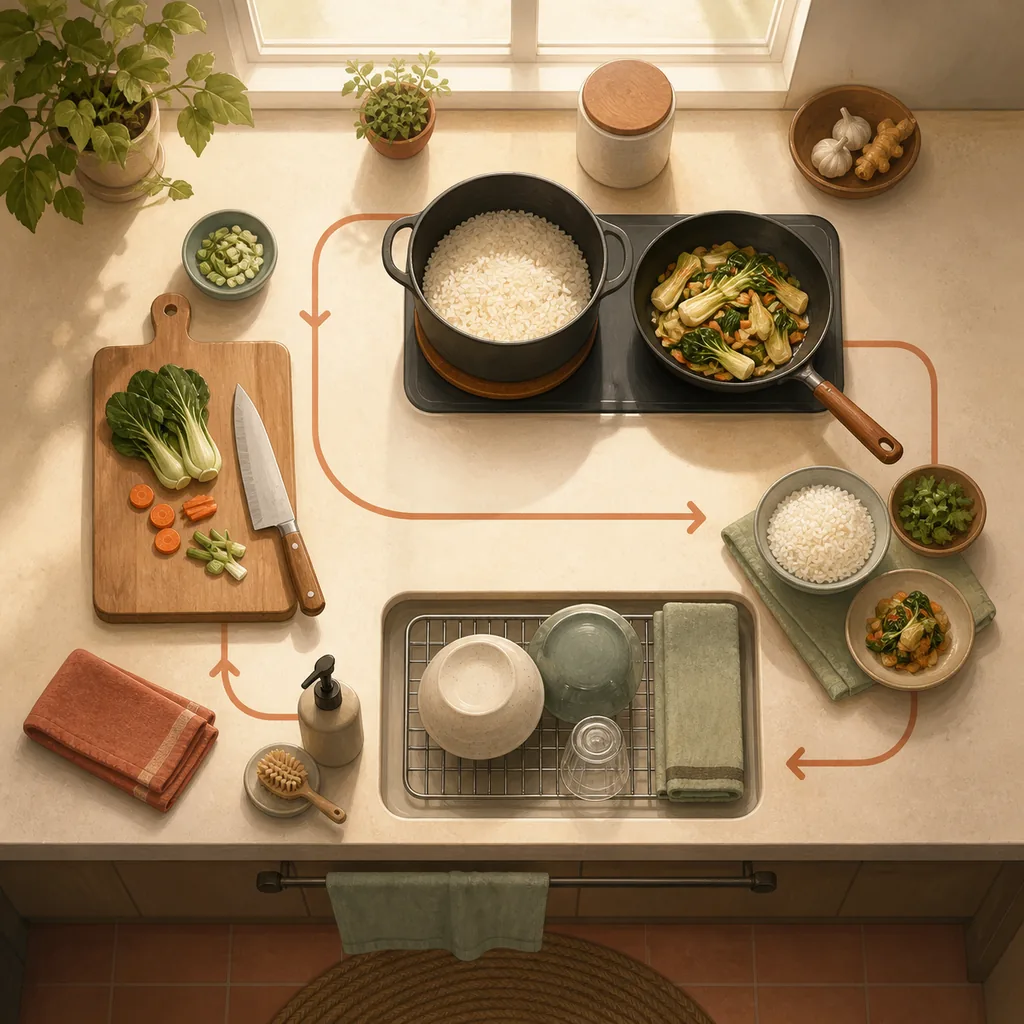
Decide on the one problem this essay will solve
I first intended this essay to be a quick reference: whether to buy a knife, how many pans to own, and how many seasonings or storage containers to keep. Later drafts added inventory, movement, cleanup, and food safety. Every part was reasonable, but together they had no center. A reader still had to guess whether somebody else’s “essential” fit their meals, hob, and sink.
Existing resources each solve one part of the problem. Equipment checklists offer a conventional starting set. Organization articles discuss zones and vertical storage. Professional kitchens stage ingredients for service. Planning guides constrain work areas and traffic. Public-health guidance sets food-safety limits. None can answer for a household which actions truly happen every week, which constraint most often stops dinner, or whether one more object will make washing and storage harder.
This revision therefore keeps one core question:
How can three recurring meals generate a shopping list for my own kitchen?
The answer begins with two test passes, not an object list. In the first pass, make three meals as usual, starting with the decision and ending when the kitchen is usable again, and record recurring bottlenecks. Then change only sequence, placement, and portion size before running the second pass. A bottleneck that remains may become a purchase candidate.
“Minimal” now has a testable meaning: within the actual limits of space, time, and energy, use as few objects as practical to complete recurring meals safely and reliably, then return the kitchen to a state from which the next meal can begin. Owning fewer things may follow from that goal; it is not the goal itself.
Choose three meals that expose different problems
Test meal types rather than exact recipes. “Rice plus one sautéed dish” and “noodles plus one blanched vegetable” represent repeated actions better than a single named recipe. Choose one meal you truly make in each of these three categories:
| Type | How to choose it | What it mainly exposes |
|---|---|---|
| Lowest-energy meal | What you will still make when tired, late, or short of time | Whether ingredients are easy to choose and retrieve, whether the smallest tool set works, and whether cleanup is light enough |
| Ordinary weekday meal | The meal pattern repeated most often in the last month | How the main knife, cookware, hob, counter, and sink hand work from one to another; whether everyday inventory is dependable |
| Highest-space-pressure meal | A meal you still repeat that has the most steps and simultaneous work; exclude an imaginary feast | Capacity conflicts, raw and ready-to-eat handling, serving, leftovers, and complete cleanup |
Also write down the test conditions: how many people eat and cook, available heat sources, the counter area on which a board can actually lie flat, sink and draining space, total available time, and any height, mobility, or other physical constraints of the cook. These conditions can reverse an object’s value. Someone who eats rice daily and owns one hob may treat a rice cooker as a way to free the heat source. Someone who rarely eats rice may gain only another inner pot to store and wash.
Do not make the kitchen unusually tidy for the test. The ordinary weekday kitchen is more informative: a cup may still be in the sink, frequent seasonings are already open, and the cook has little energy for an elaborate process.
Run the first pass in the usual way
Buy nothing and do not reorganize extensively before the first pass. Start when deciding what to eat. Finish when leftovers have been handled, food-contact surfaces have received the necessary cleaning, and frequent tools are drying or stored. Record what happened and its consequence without proposing a fix yet.
Choose three recurring meals → cook and clean as usual → record bottlenecks → change sequence, placement, or portion first → retest. Keep the current tools if the bottleneck disappears; evaluate a purchase only if it remains.
If recording will not interfere with heat control, handwashing, or cleaning, add a line whenever one of these observable events occurs. Otherwise, reconstruct it immediately after the meal:
| Observable event | What to record | Example |
|---|---|---|
| Searching | What was missing and which places were opened or moved | Two cabinets had to be searched for a lid while the water was already boiling |
| Clearing space | What had to move, and which location it released | The draining rack and an appliance had to move before the board could lie flat |
| Forced waiting | Which resource was occupied and which later step stopped | The only hob was cooking the staple, so the pan could not start |
| Rework | Which action was repeated because of sequence, contamination, or forgetting | The board needed another wash halfway through, or a forgotten ingredient had to be prepared separately |
| Improvising or abandoning | What was planned and how it was bypassed | A step was dropped for lack of a safe draining method, or replaced with a hard-to-control action |
| Ingredient loss | What was forgotten, overprepared, or left without another use | Vegetables at the back of the refrigerator never entered a meal and were discarded |
“This pan is annoying” is not yet actionable. “Two handles block the only place for a serving plate, so I must turn off the heat and move a pan before serving” names the object, time, and consequence. Record when serving begins and cleanup ends if useful. Second-by-second timing is unnecessary; the purpose is to compare two passes, not to manufacture precision without value.
When tired, use the lowest-burden version: after each meal, write only the single worst bottleneck, its consequence, and the time cleanup ended. Three meals can still reveal repetition. Use the full record below only when the cause remains unclear. Recording must not become another cooking bottleneck.
Close the record for each meal with six items:
| Item | What to record for this meal |
|---|---|
| Planned and completed meal | Which steps were removed or substituted |
| Start, serving, and cleanup complete | Three timestamps are enough |
| Searching, clearing, waiting, and rework | How often each occurred and the most consequential instance |
| Improvising or abandoning | Whether completion, quality, or safety was affected |
| Leftovers and ingredient loss | Amount, intended use, storage location, or reason for disposal |
| Changes from baseline conditions | Record only differences from the initial people, heat sources, usable space, time, or energy assumptions |
Reduce the record to five bottleneck types
A bottleneck is a constrained resource that prevents the next action, forcing waiting, clearing, rework, or an unsafe substitute. Classifying the record into five types prevents every inconvenience from becoming a purchase.
| Bottleneck | Diagnostic question | Common cause | First response |
|---|---|---|---|
| Action capability gap | Can the current tools perform a recurring action safely and reliably? | A suitable tool is absent, or the current tool is damaged, badly sized, or poorly maintained | Check maintenance and safe substitutions first; consider a purchase if the action still cannot be completed |
| Capacity conflict | Do two necessary steps need the same heat source, pan, counter, or sink at the same time? | Excessive parallel work, poor sequence, oversized portions, or a genuinely missing independent resource | Change sequence and portion size before deciding whether more capacity helps |
| Retrieval cost | Must a frequent object be searched for, carried across zones, or freed by moving something else? | Storage follows object categories instead of point and frequency of use | Give frequent actions fixed retrieval and return locations |
| Ingredient break | Is a key input missing, or is food that should be used first invisible? | Shopping is detached from the next meal, too many items are open, or cold storage hides priorities | Choose the next meal first, buy only the gap, and create a use-first location |
| Cleanup bottleneck | Why can the kitchen not return to a usable state after eating? | A meal calls too many parts, residue dries, or washing, draining, and waste have no destination | Use fewer objects, clean during waits only when heat control is unaffected, and establish a drying path |
More equipment mainly solves action capability gaps and sometimes capacity conflicts. It often worsens retrieval and cleanup. A second pan does not solve a single-hob constraint. A set of portioning containers does not solve the absence of a decision about the next meal. The bottleneck type reveals whether shopping addresses the cause.
Make no-purchase changes, then retest
I try changes in this order, moving down only when the preceding layer fails:
- Remove low-value actions. A garnish that exists only for appearance, or a bowl that performs neither preparation nor serving work, can leave the ordinary weekday process.
- Change the sequence. Start a long-wait staple or braise first, then perform short heating; schedule residue-prone cookware where it can be handled promptly.
- Change placement. Put frequent tools near their point of use while preserving the safety requirements for knives, heat sources, and cleaning chemicals. Put food that should be used first where it is visible on opening cold storage.
- Reduce simultaneous work. Make a smaller portion, turn two concurrent heating steps into a sequence, or select steps that can share the same pot of water or serving vessel.
- Maintain current tools. Repair loose parts, maintain knives and cookware according to manufacturer instructions, and determine whether the object or the method has failed.
- Only then add an object. A purchase enters the discussion only when the first five layers leave a recurring bottleneck.
Staging ingredients does not require cutting everything in advance and lining up small bowls. Prepare only what the next time-sensitive phase needs. This reduces containers and avoids leaving perishable food at room temperature without a reason. Reuse a container only when its consecutive uses create no contamination path and meet local cleaning requirements. Any utensil that has contacted raw ingredients should receive the cleaning and, where required, sanitizing specified by local guidance before touching cooked or ready-to-eat food.
Retest the same meal after the change. Compare completion time, searching and clearing, waits for constrained resources, rework, cleanup time, and ingredient loss. Change only one or two important variables per pass so the result can identify what helped. One faster run may simply contain a smaller portion. Evidence becomes stronger when the same bottleneck disappears across different meal types or the same meal remains improved on another pass.
Let repeated bottlenecks generate the shopping list
A safety problem does not need to repeat. An unstable cutting surface, damaged appliance, unavoidable cross-contamination path, or inability to judge required cooking reliably should stop the process immediately and be addressed through manufacturer instructions and local authoritative guidance. The repetition rule below ranks convenience purchases only; it is not a safety standard.
A convenience problem enters purchase evaluation when any one condition holds:
- the same bottleneck appears in at least two of the three meals;
- it returns when the same meal is retested after a no-purchase change;
- it is infrequent but prevents completion of a meal that would otherwise be made.
“Two meals” is a personal sorting rule intended to slow impulse purchases, not a clinically or ergonomically validated universal threshold. Households that bake often, require accessible tools, manage severe allergies, or cook for many people should rewrite the rule around their own risks and task frequencies.
Every candidate must then answer six questions:
| Purchase question | Answer required |
|---|---|
| Which bottleneck does it solve? | Name a meal, an action, and an observable consequence; “more convenient” is insufficient |
| Why is the current substitute inadequate? | State its actual cost in time, quality, effort, or safety |
| Is the frequency real? | List the recurring meals that use it or the recent occasions on which the problem occurred |
| Where does it live when idle? | Measure a permanent home first; use cannot depend on moving another appliance every time |
| How is it washed, dried, and maintained? | Include disassembly, consumables, and the time required to return it |
| How will it be retested after purchase? | Predict which wait, move, rework, or failure should decline, then rerun the same meal |
Only a candidate with six clear answers becomes the “next purchase.” A tool that appears in one imagined recipe goes onto a waiting list and is observed when that meal is actually made. The shopping list then stores evidence and unresolved problems rather than product wishes.
Keep a shopping reference that is genuinely useful
The original reference of “things I might buy” remains useful, but it must be read from left to right: find the action that repeatedly failed in the test, then inspect the relevant tool category.
| Recurring action | Purchase evaluation |
|---|---|
| Cutting, peeling, and dividing | Check first: whether the main knife fits the hand and common ingredients, the board is stable, and the blade is maintained correctly. Purchase is supported when: frequent ingredients cannot be handled safely and consistently after maintenance and reasonable substitution. Common mistake: completing a named knife set without solving the most frequent cutting action. |
| Boiling, blanching, braising, and steaming | Check first: lidded-pot capacity, hob compatibility, and safe removal or pouring. Purchase is supported when: frequent portions do not fit, or a safe steaming or removal action genuinely cannot be completed. Common mistake: buying a dedicated large pot for one occasional dish, or adding cookware without another heat source. |
| Sautéing, frying, and reheating | Check first: the current pan’s usable area, weight, handle, and compatibility with the turner. Purchase is supported when: food remains crowded in frequent meals, or the same meal truly needs another heating characteristic. Common mistake: duplicating the same size, or treating coating or material marketing as a cooking capability. |
| Gripping, turning, draining, and serving | Check first: whether lids, skimmers, tongs, turners, and current vessels can safely share the work. Purchase is supported when: hot liquid or fragile food repeatedly creates an uncontrolled transfer. Common mistake: buying an overlapping utensil set in which every piece serves one action. |
| Cooking a frequent staple | Check first: whether current cookware and the heat source can complete it reliably in the present sequence. Purchase is supported when: across several meals, the staple continues to occupy the only heat source and block other food after resequencing. Common mistake: buying an appliance because others use it, despite no permanent home or sufficient frequency. |
| Mixing, blending, and whipping | Check first: the time, portion, and result of the manual method. Purchase is supported when: the action is frequent, its manual cost is explicit, and an appliance replaces several real steps. Common mistake: inferring uses from “multifunction” claims without a task in the three meals. |
| Cooling, refrigerating, and carrying | Check first: capacity, seal, stacking, and cleaning of current containers. Purchase is supported when: leftovers repeatedly lack a suitable container, and the candidate meets local safe-storage requirements. Common mistake: buying a set of similar sizes while the real gaps remain portioning and date records. |
| Judging heating and storage conditions | Check first: existing equipment displays, manufacturer instructions, and authoritative guidance. Purchase is supported when: recurring food needs temperature evidence that the current method cannot provide reliably. Common mistake: replacing correct measurement and official requirements with color, habitual timing, or a connected device. |
| Washing, draining, and drying | Check first: the sink, brushes, cloths, draining area, and waste route. Purchase is supported when: cleanup repeatedly fails at one location after sequence and tool count have already been changed. Common mistake: adding hard-to-clean racks and organizers in pursuit of a tidy appearance. |
This table deliberately gives no brands, set quantities, or fixed dimensions. Pan diameter, knife type, appliance capacity, and container count acquire meaning only when joined to the number of diners, hob, hand function, normal portion, and permanent home. On the day of purchase, check manufacturer specifications, material restrictions, warranty, and local safety requirements again. Those dynamic facts do not belong in an evergreen recommendation.
Follow one complete example
Suppose one person has a single hob, a small counter, and one sink. The lowest-energy meal is frozen dumplings with blanched greens. The ordinary weekday meal is rice with tomato and egg. The highest-space-pressure meal is rice with one sautéed dish and one soup. The first pass produces four observations:
- The draining rack occupies the only surface that can hold the board, so it moves for all three meals.
- The staple occupies the only hob in the latter two meals, forcing the sautéed food to wait.
- Greens at the back of cold storage remain unseen, while another similar vegetable is bought.
- In an attempt to “prepare everything,” each meal uses three or four extra small bowls that remain to be washed after serving.
These observations do not generate four products. Start with no-purchase changes: give the rack a drying location that does not consume the preparation surface; collect use-first food in a safe location visible when cold storage opens; stage only the next phase, remove portioning bowls that perform no necessary task, and never place cooked or ready-to-eat food directly in a container that contacted raw ingredients; cook the staple first and use its covered resting or holding period for the sauté.
In the second pass, clearing, duplicate buying, and extra washing disappear. Their causes were placement, visibility, and excessive staging. The staple still creates a meaningful wait in two meals, so two options are finally compared: accept sequential heating or evaluate an appropriately sized staple appliance. A second pan is rejected because it does not add a heat source. The staple appliance remains a candidate only if its frequency, permanent home, rated power, cleaning path, and post-purchase retest all work.
The example does not conclude that everyone must buy a rice cooker. It provides something more useful: why to buy, when not to buy, and which meal can reveal whether the purchase was correct.
Use the same list for food
Kitchen shopping includes both equipment and food. Food does not require an elaborate taxonomy. When deciding the next meal, answer three questions:
- Which ingredients should be used first because of date, open state, or ripeness?
- Which of the three recurring meals can use them?
- What exact input is missing to complete that meal?
Keep use-first ingredients where storage remains safe and the food is visible when deciding what to eat. Shelf-stable, frozen, or quickly assembled ingredients support the lowest-energy meal. Replenish frequent staples, oil, and seasonings according to actual use. Select the next meal from current food before shopping, then buy only the gap. A new seasoning without two planned uses stays on the waiting list.
Leftovers are inputs for another meal as well. At serving time, decide what will be eaten now and what will be cooled and refrigerated within safe limits, then assign it a use. “Perhaps later” is not a plan. Specific temperatures, times, containers, and reheating limits still come from local public-health guidance; this personal test cannot replace them.
Treat food safety and physical needs as hard constraints
The stress test can rank convenience; it cannot trade safety for speed. Separating raw ingredients from cooked or ready-to-eat food, cleaning hands and contact surfaces, cooking foods that require it thoroughly, and controlling the time and temperature of perishable food and leftovers all follow local authoritative guidance. Color or the two sides of a board can identify intended use, but cannot replace cleaning or required sanitizing.
Pain, grip strength, height, vision, range of motion, children’s participation, severe allergies, and high-risk household members also change what “minimal” means. A low-frequency tool may still be infrastructure when it supplies necessary access or separation. Repeated pain, burn risk, electrical faults, ventilation problems, or inability to establish a safe process should end the test and lead to appropriate professional advice, not another round of purchase scoring.
This essay does not give refrigeration periods or internal temperatures for every food because those values depend on the food, handling method, people, and regional guidance. The final table links to the Hong Kong Centre for Food Safety pages for preparation, cooking, storage, and leftovers; readers elsewhere should use the corresponding local public-health authority.
Use the second pass to decide when to stop
A small kitchen need not reach zero waiting, zero movement, or zero leftovers. It needs to turn known constraints into an acceptable, repeatable arrangement. After the second pass, use these five checks to decide whether the current system is enough:
- All three recurring meals fit the time and effort bounds set in advance without an unsafe improvised substitute.
- Frequent objects have fixed retrieval and return locations, and heat sources, cookware, counter, and sink follow an explicit and acceptable sequence.
- Every frequent tool has a complete retrieve–use–wash–dry–store path, and cleanup still finishes when the cook is tired.
- Use-first food is visible, and leftovers have an intended use and safe handling method.
- Every object on the shopping list names its bottleneck, permanent home, and post-purchase test.
Stop optimizing when these conditions hold. Keeping one or two understood inconveniences that you willingly accept usually saves more space than another purchase. If the household, home, physical needs, or recurring meals change, choose three meals again and run another pass.
I still need a kitchen shopping reference. It simply no longer begins with products. It begins with an actual dinner and lets repeated facts decide the next object. That list is much shorter and much closer to the minimal system a small kitchen actually needs.
How the sources support the method
| Source | What this essay uses | What the source cannot establish |
|---|---|---|
| Chen and colleagues’ rapid scoping review of kitchen ergonomics in health and healthcare | Its sociotechnical framework organizes layout, tools, special needs, and hazards, showing why object count alone is insufficient | A single minimum tool list applies to every household, or health and healthcare findings transfer without qualification |
| The National Kitchen & Bath Association Kitchen Planning Guidelines | Barriers, traffic, and landing space between work centers affect a cooking process | The classic work triangle replaces observation of real cooking, or a renter must rebuild the kitchen |
| The UK Food Standards Agency’s Kitchen Life 2 observation study | Cameras, interviews, and temperature records in 70 household kitchens show that physical space, knowledge, and beliefs all affect actual behavior | The sample ranks tools for households worldwide, or validates this essay’s three-meal threshold |
| Hong Kong Centre for Food Safety guidance on preparation, cooking, storage, and leftovers | Separation, cleaning, thorough cooking, and safe time and temperature are hard constraints | A personal workflow essay replaces local guidance for a specific food, person, or appliance |
| This essay’s synthesis | The three meal types, five bottleneck types, no-purchase sequence, two-meal repetition rule, and six purchase questions | These personal sorting methods are a validated scale, ergonomics standard, or food-safety protocol |
Comments
Comments are public and stored in GitHub Discussions. This page connects to giscus.app and GitHub and sends the current page path only after you show comments manually or enable automatic loading. The first load is about 0.13 MB; actual usage varies with comment content. Do not include private information.